A battery charging at a particular moment may be responding to a local charge-recovery rule or to a request issued by another control system. The observed power flow alone does not reveal who made that decision.
Operating modes in a DC-coupled storage solution therefore have a decision source as well as an energy objective. Distinguishing a measured condition from an externally supplied instruction makes changing grid conditions easier to relate to the action actually being requested.
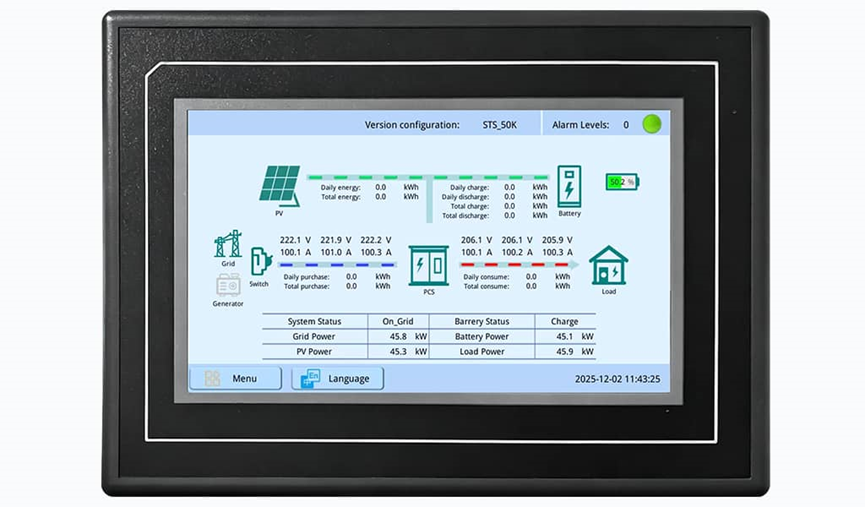
Local Conditions as the Basis for an Action
A local threshold compares an observed condition with a configured reference. Low battery state of charge can initiate a recovery task, while limited solar availability describes which resources are present to support it. Those conditions provide a local basis for action within a DC-coupled storage solution, rather than identifying a command received from an upstream controller.
Battery-priority operation uses a preset low SOC threshold to begin charging from available sources, including solar or the grid. The decision is tied to the battery condition under that selected mode. Available supply still determines which source can contribute to the requested recovery; naming an eligible source does not make it present at the installation.
The prolonged low-solar sequence uses the minimum battery SOC as the condition for requesting diesel-generator starting. This is a local state-based request for another source. The request identifies a need for supply, while the generator’s actual readiness and configured connection determine how that request reaches physical equipment.
Recovery Targets Define the Requested Outcome
Target SOC specifies the charge condition being sought, not a constant charging-power instruction. In a DC-coupled storage solution, battery-priority charging continues until that target is recovered. The target describes completion of the selected recovery duty, while the power available during recovery can vary with the connected sources and concurrent demand.
Within one recovery cycle, the starting threshold and target SOC answer separate questions. The threshold identifies the condition that initiates charging; the target identifies the charge condition sought. Tracking the observed SOC against those references connects the initial event with the ongoing recovery task without merging their different roles.
Grid availability also changes the practical context of that objective. A grid connection present on a drawing may be unavailable during an interruption, leaving a different set of sources to consider. Source availability describes the resources supporting recovery; the active mode identifies why the recovery is being requested.
A configured recovery target needs an identified scope and setting source. The site record can distinguish the origin of that setting from the equipment observing SOC and carrying out charging. That distinction separates a standing local objective from an individual power request issued by another control system.
An Upstream Instruction Has a Different Origin
Dispatch-command operation assigns the charging or discharging decision to an upstream EMS. The receiving equipment follows that instruction at the relevant port, delivering or absorbing the requested power. Its assigned task is execution of the upstream request, rather than independently selecting a competing energy objective for that port.
The commanded exchange needs an identifiable electrical boundary. A request concerning battery charging and one concerning power delivered at another connection have different objects, even where the same installation participates in both. Recording the port and intended direction connects the external decision to the physical duty expected from the receiving equipment.
An action can consequently resemble local recovery without having the same origin. Charging observed at the battery could follow an upstream instruction even when the battery is also below a locally relevant threshold. Identifying the active control arrangement preserves that distinction without assuming that coincident conditions establish a priority or conflict-resolution algorithm.
Where the Requested Action Reaches Site Equipment
Generator coordination in the GWTime 64 kW/128 kWh system requires the actual generator’s rated power, voltage, frequency and controller model. Its available dry-contact or communications interface forms another integration input. These details locate the physical control relationship through which a requested start or stop can be configured for the installed generator.
Site voltage remains a separate execution condition after a generator control interface has been identified. The 400 V three-phase application of the 64 kW/128 kWh configuration is checked against the site’s phase arrangement, frequency, connection requirements and any involvement of a transformer. A request for generator support consequently needs a compatible electrical connection as well as the controller interface through which the request is conveyed.
Utility and diesel-generator inputs reach the built-in ATS within the GWTime four-in-one inverter family. That device provides the assigned switching function, while PCS handles conversion and EMS coordinates operation. External MPPT equipment continues to serve the PV side, keeping the array’s DC conversion stage identifiable within the overall operating arrangement.
Installation-specific generator sequencing remains part of the GWTime integration task. Minimum generator loading, permitted battery-charging power and transfer logic are configured alongside start/stop behaviour. The resulting settings connect an operating request to the capabilities of the particular generator, rather than treating automatic control as permission to connect any source without engineering.
An interpretable operating mode identifies who initiates the action, what outcome is requested and where the action is executed. Local SOC recovery and upstream dispatch can produce similar visible power flows for different reasons. The active decision source explains that difference, while the configured site interfaces make the requested operation executable.